Automatic backup on Windows 11 to a USB or external drive
Most people know they should back up, and most people do not. Copying folders by hand works until you forget for a few months. This article explains the manual way first, then how to make the backup happen on a schedule, and it is honest about what automatic means here.
The simple manual way
You can back up with nothing but File Explorer. Plug in a USB drive or external disk, open the folder you care about, copy it, and paste it onto the drive. For a small set of documents this is perfectly fine.
The weak points are memory and mistakes. You have to remember to do it, you have to remember what changed, and pasting over an older copy can replace a version you wanted to keep. Windows also has its own backup options in Settings. This article does not cover those in detail, so look at them too if you want to compare.
What automatic means in Folder Backup
Folder Backup is a free app from Tidy Button on the Microsoft Store. It has three ways to run a backup. You press Back up now. Or it runs every few hours. Or it runs when the backup drive is plugged in.
The last two only work while the app is open. It does not install a background service, so when the app is closed nothing runs by itself. You can ask the app to start with Windows and keep it minimised, which gives you a schedule without a window in your way. That is the honest meaning of automatic here, and it is worth knowing before you rely on it.
Set up your first backup
Plug in your USB drive or external disk first if you want to back up to it. You can also back up to a network share or another folder.
- Open Folder Backup and stay on the Backups screen.
- Press Create your first backup.
- Press Add folders and choose the folders you want to protect.
- Press Choose folder under where to keep the backup, and pick a folder on your drive.
- Under when to back up, choose how it should run. Leave Only when I press Back up now selected if you want to start each backup yourself.
- Press Create backup.
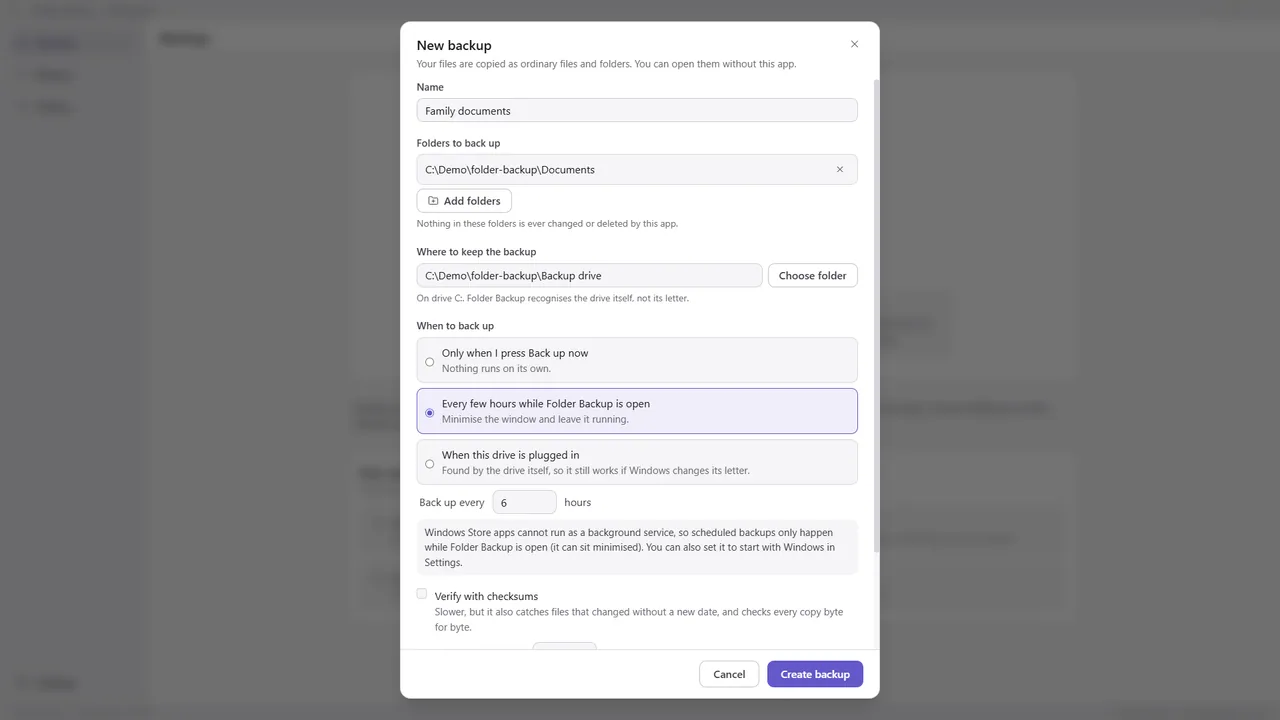
Pick the folders, the place for the copy and when it should run
Preview, then back up
Before the first copy you can see exactly what will happen. The preview shows how many files are new, how many changed and how many were removed, and how much space the backup needs. Nothing is copied until you press the button.
The copy is made of ordinary files and folders. You can open it in File Explorer with or without this app, so there is no special backup format to get locked into.
- On the Backups screen, press Preview what will happen.
- Read the numbers. If you are happy, press Looks right: back up now. Later backups use the Back up now button.
- Watch the progress bar. Press Stop if you need to cancel the run.
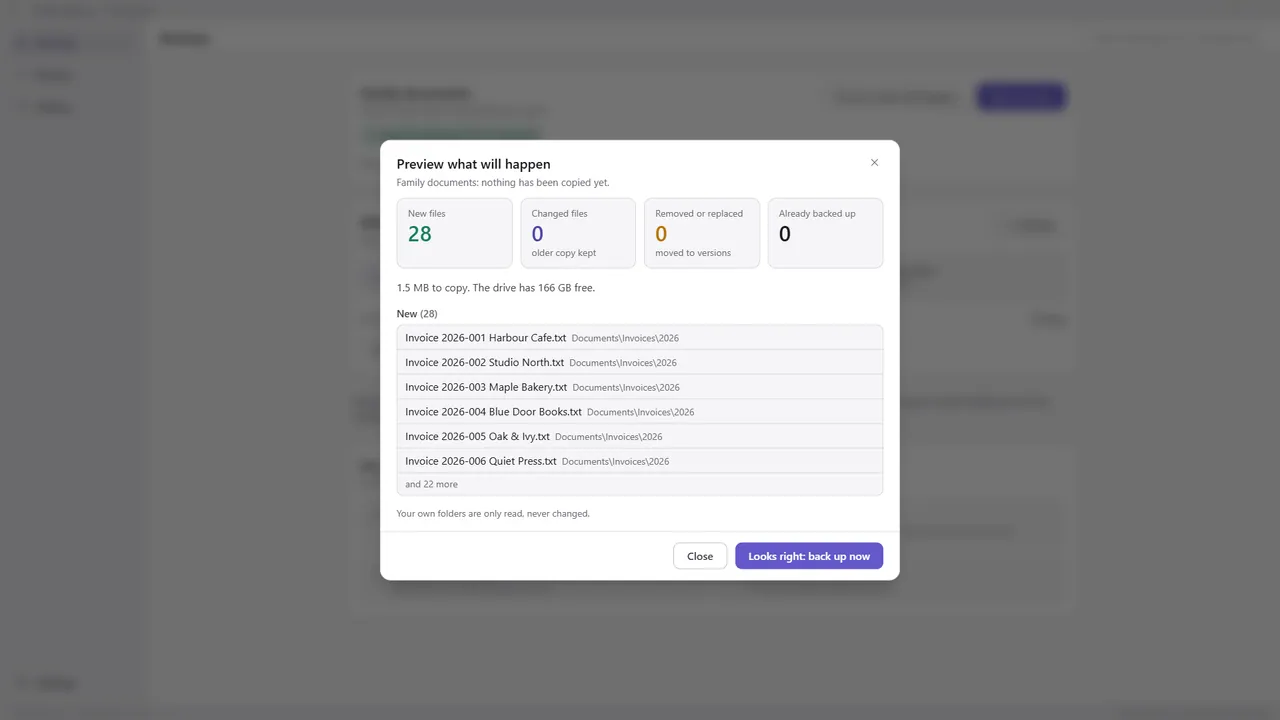
The preview shows new, changed and removed files before anything is copied
Run it every few hours or when the drive is plugged in
Closing the app stops scheduled backups until you open it again. If the drive is not connected, the preview and Back up now buttons are greyed out until you plug it in. The app recognises the drive itself, even if Windows gives it a different letter.
- On the Backups screen, press Settings next to the folders list.
- Under when to back up, choose Every few hours while Folder Backup is open and type the number of hours. Or choose When this drive is plugged in.
- Press Save changes.
Older versions and getting files back
When a file changes or disappears from your folder, the previous copy goes into a dated versions folder in the backup. A backup never overwrites or deletes it. That is how you can get back last week's version of a document.
To restore, open the Restore screen, choose Latest backup (current) or an older version, tick the files you want, and press Restore to original location or Restore to another folder.... If a file would be replaced, the app asks first and saves the file it replaces.
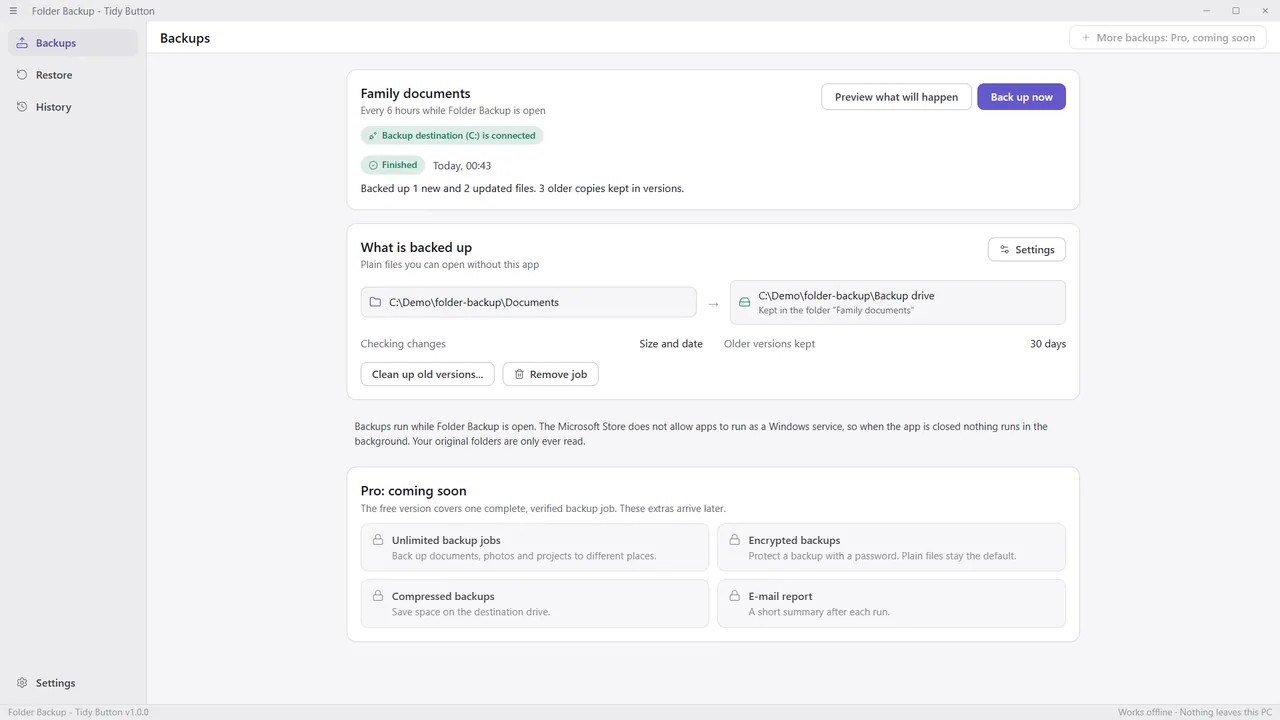
After a second run, older copies sit safely in a versions folder
What the free version limits
The free version has one backup job. That is enough for one set of folders going to one place. A Pro add-on is planned with unlimited jobs, encrypted and compressed backups and an e-mail report, but it is not available yet.
Two other honest limits: shortcuts and junctions are not followed, and they are listed in the history. A backup on the same drive as the original does not protect you if that drive fails, so use a separate drive.
Questions
Does the backup run when the app is closed?
No. Scheduled backups only run while Folder Backup is open, because the app does not install a background service. You can ask it to start with Windows and keep it minimised.
Will the backup change or delete my own files?
No. Your own folders are only ever read. A restore to the original place writes into them only when you ask, and it saves any file it replaces first.
How do I know the copy is good?
Every file is written to a temporary name, compared by size, and only then put in place. You can also turn on checksums. If a backup is cut off, the next one carries on without leaving half-written files.
Does it need an account or the internet?
No. There is no account, no ads, no tracking and no network use. A network share is used only if you choose one as the place to keep the backup.
If you want a backup you can open like any other folder, with older versions kept and every copy checked, try Folder Backup. It is free on the Microsoft Store, works offline and needs no account. Set it up once, keep it open or minimised, and let it run.
More from Folder Backup
Questions or something missing? Support is by email, and a person reads it.